Artificial intelligence is changing how people research businesses. Potential customers can now ask AI tools to compare companies, summarize reviews, recommend providers, identify common complaints, or explain whether a brand appears trustworthy.
The answers generated by AI may influence a customer before they visit your website, read your sales materials, or contact your team. If AI systems encounter inconsistent business information, outdated pages, weak reviews, or repeated negative coverage, the resulting summary may not represent your brand accurately.
Improving your brand’s AI reputation means strengthening the information AI systems can find and understand about your business. This includes your website content, business profiles, reviews, media coverage, professional listings, social accounts, and other public sources.
A strong AI reputation cannot be created through one technical update. It develops from accurate information, credible evidence, consistent messaging, positive customer experiences, and active reputation management.
What Is an AI Reputation?
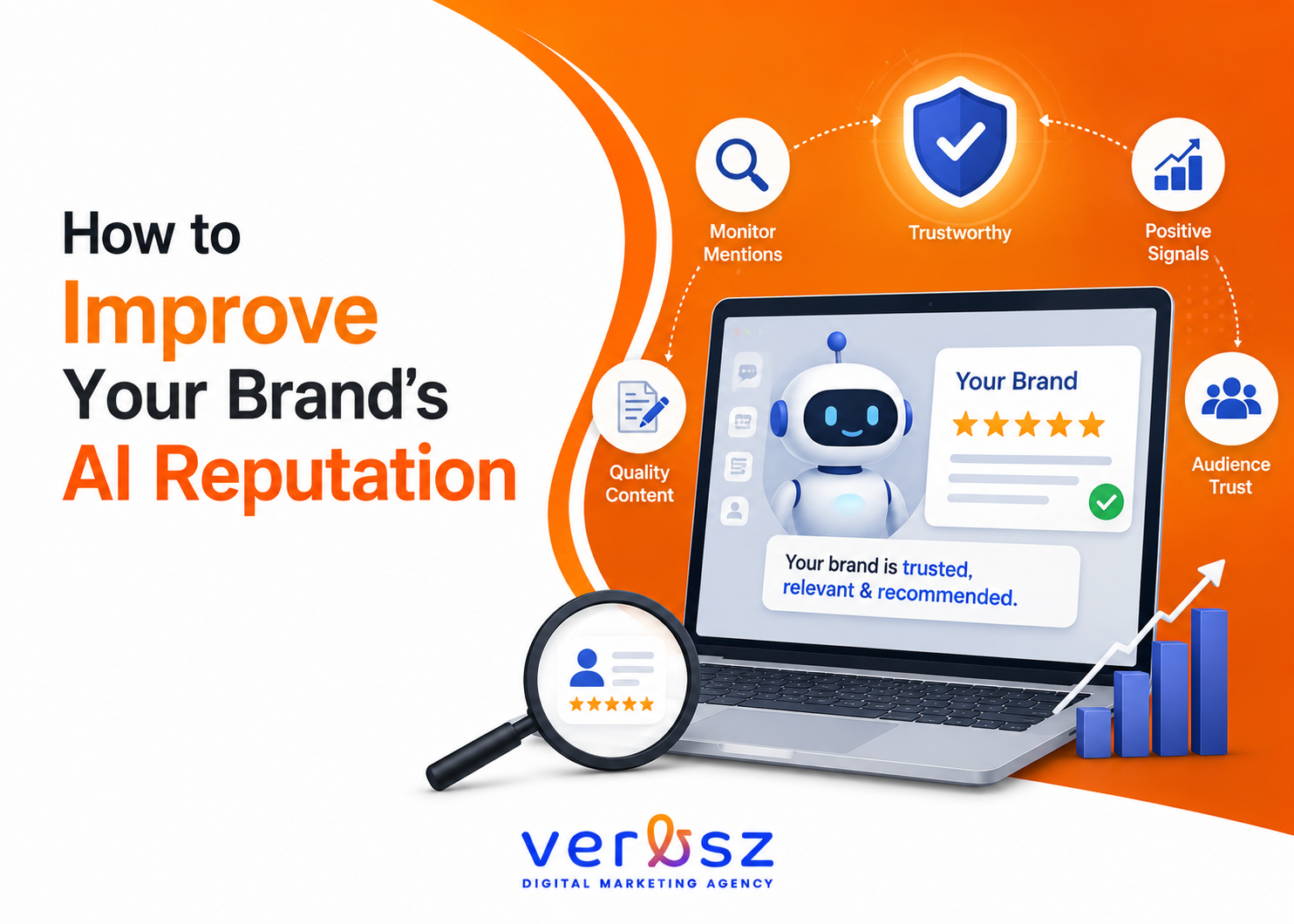
Your brand’s AI reputation is the overall impression AI-powered systems may form when answering questions about your company.
A user might ask:
- Is this company trustworthy?
- What services does this business provide?
- What do customers say about the brand?
- Has the company received any complaints?
- Which industries does the company serve?
- How does this business compare with its competitors?
- Is this company suitable for my project?
AI systems may use information from your website, search results, reviews, directories, articles, social profiles, public discussions, and other accessible sources to create a response.
Your AI reputation is therefore connected to your broader digital reputation. The difference is that AI may summarize information from several sources into one direct answer, making inconsistencies or recurring negative themes more visible.
Can You Directly Control What AI Says About Your Brand?
You cannot directly control every AI-generated answer about your company. Different systems may use different search indexes, sources, models, and methods for generating responses.
You can, however, improve the quality and consistency of the public information available about your brand. When your website and external profiles provide clear, current, and well-supported information, AI systems have stronger evidence to use.
The goal should not be to manipulate AI responses. It should be to build a reliable online presence that accurately represents your company.
Audit Your Existing AI Reputation
Before making changes, examine how your brand currently appears across AI and traditional search experiences.
Search for your brand name using several types of questions. Ask what the company does, who it serves, where it operates, whether it is trustworthy, how it compares with competitors, and what customers commonly say about it.
Review the answers for incorrect services, outdated locations, missing leadership information, unsupported claims, old complaints, or confusion with similarly named businesses.
You should also perform branded searches through traditional search engines. Review the first few result pages, business profiles, review platforms, social accounts, directory listings, news coverage, and forum discussions.
Record the issues you find and separate them into three categories: inaccurate information, missing information, and negative but legitimate information. Each category requires a different response.
Incorrect details should be corrected. Missing information should be added to authoritative sources. Genuine criticism should be addressed through service improvement, professional responses, and stronger customer experiences.
Make Your Brand Easy to Understand
AI systems need clear language to identify your company and connect it with the correct services, industries, locations, and expertise.
Your homepage should explain what the company offers, who it serves, and what makes it relevant. Avoid relying entirely on broad statements such as “We deliver innovative solutions” or “We help businesses reach their full potential.”
A clearer description would identify the brand, core services, target audience, and geographic reach.
For example:
“Verbsz Marketing is a digital marketing agency providing SEO, paid advertising, social media marketing, content, and website development services for businesses across multiple industries.”
This type of statement gives AI systems and potential customers useful information without relying on exaggerated language.
Core brand details should also appear naturally across the About, Services, Contact, and location pages. The information should remain consistent without repeating the same paragraph throughout the website.
Strengthen Your About Page
The About page is an important source of brand information. It should explain who the company is, what it does, how long it has operated, who leads it, and which customers or industries it serves.
Include accurate information about the company’s history, leadership, qualifications, experience, locations, partnerships, and working approach.
Leadership profiles should identify real people and explain their professional responsibilities. If the company has recognized certifications, awards, memberships, or partnerships, present them with enough context for readers to understand their significance.
Avoid filling the About page with unsupported claims such as “the most trusted company” or “the number one provider.” Stronger trust signals come from verifiable experience, client outcomes, professional credentials, and transparent company information.
Keep Business Information Consistent
Conflicting business details can confuse customers, search engines, and AI systems.
Review your company name, address, phone number, website, service descriptions, operating hours, social profiles, and location information across all public platforms.
Old addresses, duplicate profiles, inconsistent brand names, and outdated service descriptions should be corrected. If the company has changed its name, merged with another organization, moved locations, or discontinued a service, explain the change clearly on authoritative pages.
Businesses with multiple locations should maintain accurate information for each location. Do not create profiles or pages for places where the company does not have a legitimate presence.
Consistency helps AI systems connect different online references with the correct business entity.
Improve the Quality of Your Website Content
Your website is one of the few reputation sources you control directly. It should provide complete, accurate, and useful information about your company.
Each main service should have a focused page explaining what the service includes, who it supports, how the process works, and what customers can expect.
Industry pages should reflect genuine experience rather than changing only the industry name within a repeated template. Location pages should include real service information and useful geographic context.
Educational content can strengthen your reputation by demonstrating knowledge. Articles should answer relevant customer questions, explain complex subjects clearly, and provide original insights where possible.
Review older content regularly. Update statistics, services, team information, examples, and recommendations. Outdated articles can continue appearing in search results and may influence AI-generated answers long after the information has changed.
Demonstrate Experience With Evidence
AI reputation improves when positive brand claims are supported by credible evidence.
Case studies can show how your company approached a real challenge, completed the work, and produced measurable results. The strongest case studies explain the starting situation, strategy, implementation, and outcome.
Client testimonials may also build trust, particularly when they include specific details about the service and customer experience. Obtain permission before publishing client names, company information, or project results.
Awards, certifications, partnerships, and professional memberships can support credibility when they are current and relevant. Explain what each recognition means instead of displaying unexplained logos.
Original research, expert commentary, technical resources, and documented processes can further establish subject authority.
The objective is to give customers and AI systems enough evidence to distinguish real experience from promotional claims.
Build a Strong Review Profile
Customer reviews are an important part of online reputation. Recurring themes across reviews may influence how people and AI systems understand a brand.
Encourage genuine customers to share feedback on the platforms most relevant to your industry. Requests should be neutral and should not pressure customers to leave only positive reviews.
Do not purchase reviews, create fake accounts, or offer rewards that violate platform policies. Artificial review patterns may damage trust and create long-term reputation problems.
The quality of the review matters as much as the rating. Detailed feedback about communication, service, professionalism, results, or support gives potential customers more context than a short five-star review.
Review generation should be part of the customer experience. Ask for feedback after a meaningful milestone, completed service, successful delivery, or resolved support interaction.
Respond to Negative Reviews Professionally
Negative reviews are not automatically harmful. How a company responds can influence how future customers interpret the situation.
A professional response should acknowledge the concern, avoid arguments, protect customer privacy, and offer an appropriate way to continue the discussion.
Do not accuse reviewers of dishonesty without clear evidence. Avoid publishing confidential customer details to defend the company. Even if the criticism appears unfair, an aggressive response can create a larger reputation problem.
If a review identifies a genuine service failure, correct the underlying issue. Improving the customer experience is more effective than publishing a defensive reply.
When a review violates a platform’s policies, use the proper reporting process. Document the reason for the request and avoid encouraging employees or supporters to attack the reviewer.
Earn Credible Third-Party Mentions
Your website describes your business from your own perspective. Independent sources can provide additional confirmation.
Relevant third-party mentions may come from professional associations, trusted directories, local business organizations, industry publications, client websites, event pages, podcasts, interviews, research citations, or news coverage.
Focus on relevance and credibility rather than the number of mentions. A profile in a respected industry publication may provide more value than dozens of low-quality directory listings.
Digital public relations can support AI reputation when it generates accurate coverage around meaningful company developments. This may include original research, a major project, an expert contribution, an event, a partnership, or community involvement.
Avoid paying for low-quality articles that make exaggerated claims. Poorly written sponsored content can create inconsistent information and weaken brand trust.
Develop Recognizable Expert Voices
AI systems and potential customers may evaluate the people associated with a company as part of its reputation.
Identify subject matter experts within your organization and connect them with relevant content. Their author profiles should explain their roles, experience, and areas of knowledge.
Experts can contribute articles, research, commentary, webinars, interviews, case studies, and educational videos. Their public messaging should remain aligned with their real expertise.
This approach gives the brand identifiable human authority. It also helps readers understand who is responsible for the information they are using.
Expert visibility should develop naturally. Assigning every article to an executive who did not contribute to the content can weaken accountability.
Use Structured Data Correctly
Structured data can help search systems interpret important information about your company and website.
Organization markup can identify the business name, website, logo, contact details, and related profiles. LocalBusiness markup may support location information such as address, telephone number, and business hours.
Article markup can identify authors, publication dates, and modified dates. Other schema types may be appropriate for products, services, events, videos, or job postings.
The structured data must match the visible page content. Do not add false reviews, ratings, addresses, awards, or services.
Schema markup can clarify information, but it does not create a positive reputation on its own. The underlying business information must still be accurate and credible.
Remove or Correct Duplicate Information
Duplicate and outdated content can create confusion about which information is current.
Businesses often accumulate old service pages, previous location pages, campaign landing pages, press releases, directory listings, and duplicate social profiles. These sources may contain different descriptions, contact details, prices, or team information.
Conduct regular content audits to identify pages that should be updated, combined, redirected, archived, or removed.
When consolidating content, preserve the strongest version and redirect outdated URLs where appropriate. Use canonical tags correctly when similar pages need to remain accessible.
Third-party information can be more difficult to update. Contact the publisher or platform with a clear correction request and provide the accurate source information.
Address Inaccurate AI Answers
If an AI system provides incorrect information about your brand, identify the possible source before attempting to fix the answer.
Search for the incorrect statement online. It may appear on an outdated website page, business directory, old press release, review, social profile, or similarly named company’s listing.
Correct the inaccurate source where possible. If the information originates from your own website, update the page and make sure the corrected version is crawlable and indexable.
If an external publisher controls the source, request a correction professionally. Explain the inaccurate information and provide evidence supporting the correct details.
After correcting the source, allow time for search indexes and AI systems to discover the update. AI-generated responses may not change immediately.
Manage Legitimate Negative Information
Some negative information cannot and should not be removed. A past service problem, public complaint, legal issue, or operational failure may remain part of the brand’s history.
In these situations, the company should provide accurate context and demonstrate what changed. A factual statement may explain the issue, the corrective action, and the current status.
Avoid creating large volumes of promotional content to hide legitimate criticism. Reputation repair is stronger when the company acknowledges valid concerns and provides evidence of improvement.
New reviews, updated policies, customer service improvements, leadership changes, and documented results can gradually create a more complete picture of the brand.
Monitor Brand Mentions Regularly
AI reputation management is an ongoing process. New reviews, discussions, articles, and business listings can influence how the company appears online.
Monitor the company name, common misspellings, product names, leadership names, and important branded queries.
Pay attention to recurring themes rather than reacting to every individual mention. If several customers raise the same issue, the pattern may reveal an operational problem that needs correction.
A practical monitoring process should involve marketing, customer service, sales, leadership, and legal teams when appropriate. Clear ownership helps the business respond consistently.
Prepare for Reputation Issues
Every company should have a basic plan for handling inaccurate information, negative coverage, customer complaints, data incidents, or public controversies.
The plan should identify who reviews the issue, who approves responses, which facts can be shared, and which communication channels should be used.
Fast responses are useful only when they are accurate. Publishing incomplete or contradictory statements can increase confusion and provide additional material for AI systems to summarize.
The company should maintain a central source of verified information during a significant issue. Updates should be factual, dated, and consistent across the website, social accounts, customer communications, and media responses.
Connect Reputation With Customer Experience
Brand reputation begins with what customers experience.
If customers regularly encounter poor communication, missed deadlines, unclear billing, inconsistent service, or weak support, reputation marketing will not solve the underlying issue.
Review feedback with operational teams. Identify which problems occur repeatedly and determine whether changes are needed in onboarding, service delivery, communication, quality control, billing, or customer support.
Positive customer experiences create stronger reviews, referrals, testimonials, case studies, and brand mentions. These signals support both traditional reputation management and AI reputation.
Measure Your AI Reputation
AI reputation cannot be measured with one score. Use several indicators to understand how your brand is represented.
Track branded search results, review ratings, review themes, sentiment, share of positive and negative mentions, referral traffic, branded search volume, and changes in customer inquiries.
Repeat important AI queries periodically and document how the answers change. Review whether the brand is described accurately, whether outdated information continues to appear, and which sources are cited or reflected.
Sales teams can ask prospects how they discovered the company and what information influenced their decision. This can reveal whether AI tools are contributing to brand awareness or lead generation.
The final measure is business impact. A stronger reputation should support greater trust, more qualified inquiries, better sales conversations, and improved customer retention.
Common AI Reputation Mistakes
One major mistake is trying to manufacture authority through fake reviews, low-quality articles, purchased mentions, or unsupported awards. These tactics may create short-term visibility but introduce contradictory or unreliable information.
Another mistake is focusing only on AI tools while ignoring traditional search, review platforms, business directories, and customer experience. AI reputation is built from the broader digital information available about the brand.
Businesses should also avoid publishing identical company descriptions across every page and platform. Core facts should remain consistent, but each source should provide useful context for its audience.
Finally, do not treat every negative mention as something that must be removed. Constructive criticism can help identify service problems and gives the company an opportunity to demonstrate accountability.
Conclusion
Improving your brand’s AI reputation starts with building a reliable digital reputation. Your company should be described clearly, consistently, and accurately across its website and relevant external sources.
Strong service pages, current business information, credible reviews, detailed case studies, expert content, accurate structured data, and professional responses to criticism all contribute to a stronger online presence.
AI systems may interpret and summarize this information in different ways, so no business can guarantee a specific answer. The best approach is to provide clear evidence of who you are, what you do, and how customers experience your brand.
Verbsz Marketing helps businesses improve their online visibility, content authority, review presence, and digital reputation. Contact Verbsz Marketing to develop a reputation strategy that supports customer trust, AI-driven discovery, and qualified lead generation.
Frequently Asked Questions
What is an AI reputation?
An AI reputation is the overall impression AI-powered systems may present when users ask questions about a company, its services, credibility, reviews, or customer experience.
Can a company control what AI says about it?
A company cannot directly control every AI-generated response. It can improve the quality, accuracy, consistency, and credibility of the public information available about the brand.
Do customer reviews affect AI reputation?
Customer reviews can influence how a brand is understood online, particularly when several reviews repeat similar positive or negative themes.
How can incorrect AI information be corrected?
Identify the online source of the inaccurate claim, correct the information where possible, and ensure the updated source is accessible. AI answers may take time to reflect the change.
Does structured data improve AI reputation?
Structured data can help systems interpret business information, but it does not establish reputation by itself. It should support accurate website content and verifiable brand information.
How often should a company monitor its AI reputation?
Brands should monitor important AI and branded search queries regularly. The appropriate frequency depends on company size, review volume, public visibility, and reputation risk.